Hyundai Alcazar Review
The Hyundai Alcazar has been launched in India at a price of between Rs. 16.30 – 20.15 lakhs (ex-showroom, Delhi).
Hyundai Alcazar Pros
• A 3-row family car that’s well-built inside out
• User-friendly interiors look really good (brown shade is awesome) and have quality parts
• 2.0L NA petrol & 6-speed AT deliver a very smooth and refined driving experience
• Economical 1.5L diesel is available in MT & AT variants. Offers good driveability
• Comfortable ride quality with neutral road manners
• Unladen ground clearance of 200 mm is perfect for Indian roads
• The Alcazar’s safety package includes 6 airbags, ESP, all-wheel disc brakes, auto-hold, TPMS etc.
• Impressive kit (fully digital instruments, 360-degree camera, 2nd-row wireless charger, panoramic sunroof, paddle shifters, Bose sound system, cooled seats & loads more)
• Hyundai’s competent after-sales service & wide dealer network
Hyundai Alcazar Cons
• Oddball love-it-or-hate-it face. We find the Alcazar’s front design to be weird & overdone
• 2nd-row legroom is mediocre (captain seat variant). Compromises have been made to accommodate the 3rd-row & boot
• 3rd-row seat is best suited to kids only. Not really a place for adults
• Rs. ~3 lakh OTR premium over the Creta on the higher variants is too much!
• Nothing for enthusiasts here. The 2.0 AT is tuned very conservatively
• Diesel’s 113 BHP & 250 Nm – although adequate – are the lowest in the segment
• The Creta 1.4L DCT is a lot, lot more fun to drive
• Competitors like the Tata Safari, MG Hector Plus & XUV500 offer way more spacious cabins
• Some misses (no petrol AT 7-seater variant, auto wipers, illuminated window buttons, full-size spare tyre on top trims etc.)
This review has been jointly compiled with Aditya & GTO. Thanks to them for the expert observations!

Introduction
The Alcazar is a relatively low-risk attempt by Hyundai to expand its market and take a shot at the 6-7 seater segment. It already has the enormously successful Creta which is the base for this car. To spend a few crores in stretching & converting the Creta to a 3-row crossover is totally worth it. After all, Hyundai hasn’t ever had a 3-row car in the mainstream segments (the last attempt at a 7-seater SUV was the Santa Fe). Who’s the competition? You have the Tata Safari, MG Hector Plus, Innova Crysta and the Mahindra XUV500 for now, but IMHO, the real competitors to this car are the 5-seater Creta & Seltos. India being the unique market that it is, customers will be cross-shopping between these cars and more.
Hyundai Alcazar Price & Brochure
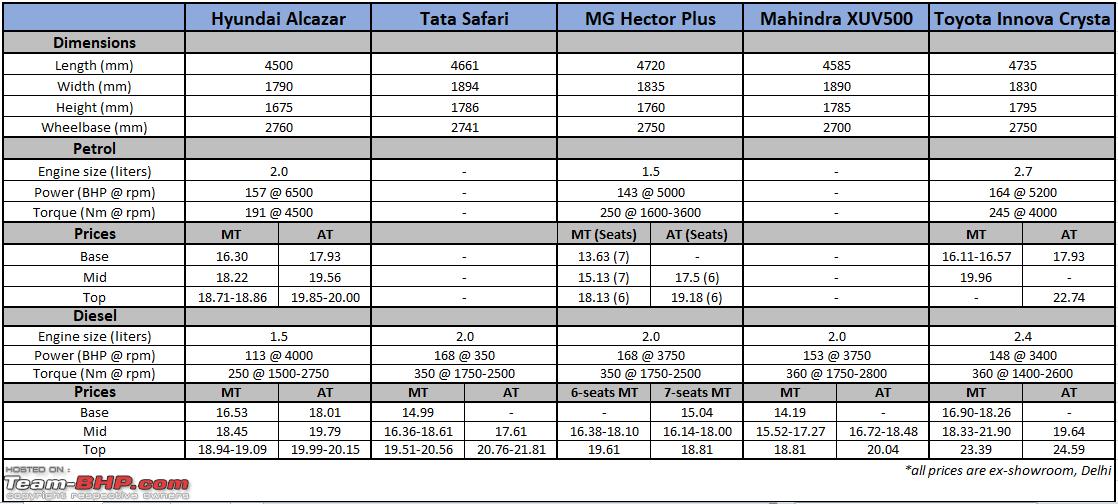
Hyundai’s stand on the Alcazar’s pricing is that their base variants are comparable to the mid variants of the competition in terms of kit. This is the reason why the starting price is higher than others. One look at the brochure and you’ll see that it is true to an extent, as the base ‘Prestige’ variant is not bare basic and comes with a considerable amount of features. Another point to note is that Hyundai’s 1.5-litre diesel engine has the lowest capacity in its class and is the least powerful (but also economical). This has allowed them to undercut the competition in the top-end diesel automatic variant (not by much though). But then, in terms of actual cabin space, the Alcazar offers lesser than all of these cars:
You can download the 2021 Hyundai Alcazar brochure here – Hyundai Alcazar Brochure.pdf
Exterior
With the new Creta on the streets for some time now, not a lot of people notice the Alcazar at first glance. Although, it’s not just about the resemblance in design, even in terms of dimensions, the Alcazar isn’t what you would call a ‘BIG’ SUV like the competition. Yes, it is bigger than the Creta on paper, but in the flesh, few people will notice it. The Alcazar measures 4,500 mm in length (200 mm more than Creta), 1,790 mm in width and 1,675 mm in height (40 mm more). Overall build & quality levels are satisfactory:

The front end design will polarise opinions. One of the things that GTO, Aditya and myself unanimously agreed on almost instantly was the ugly front end design. It’s far from classy and the excess use of chrome is a serious turn-off. Before you make up your mind though, we suggest checking it out in person first. Some people do dig the radical styling (as seen with so many Creta owners), including many BHPians: 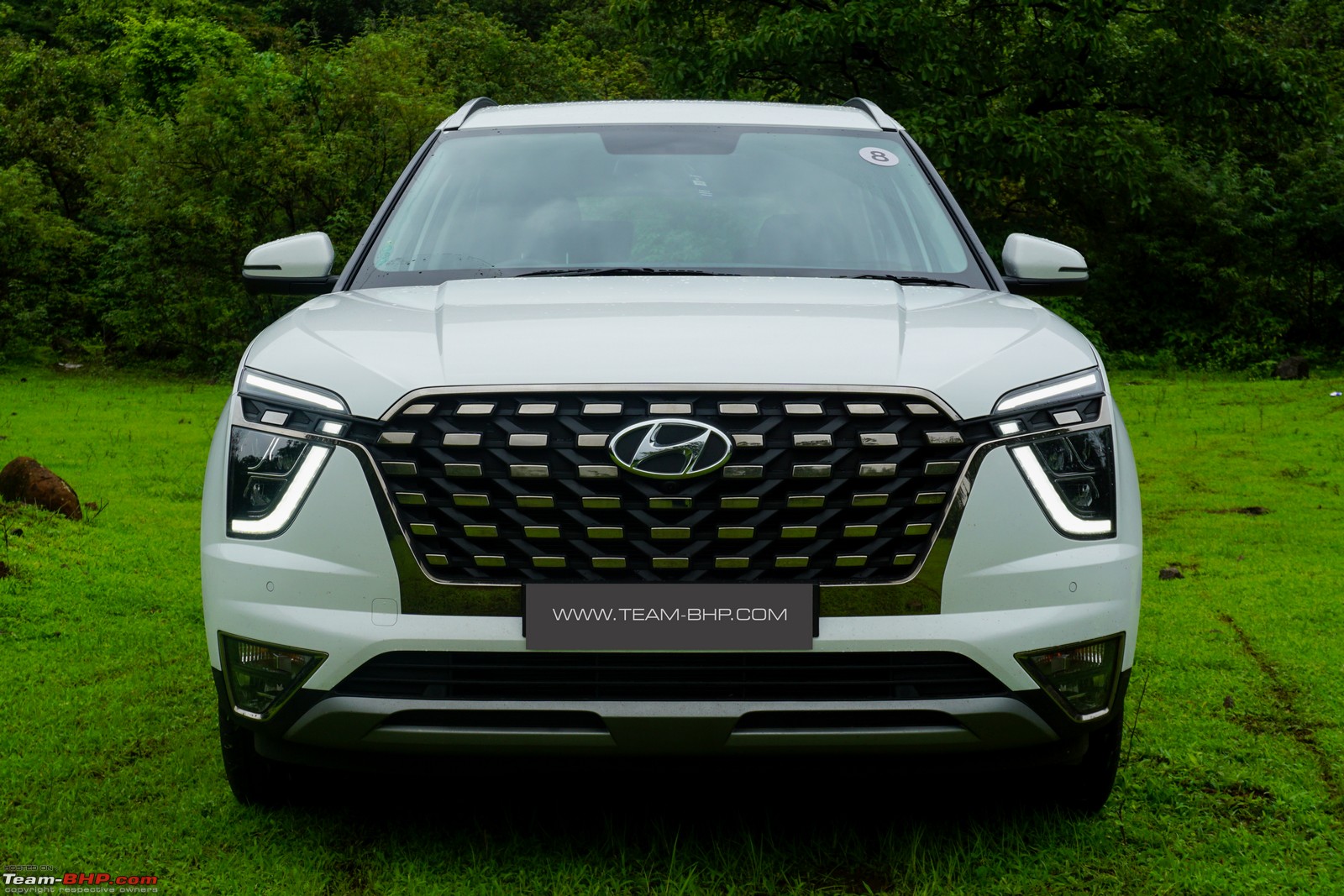
The Alcazar shares the SU2 K-series platform with the Creta, albeit this is the long-wheelbase version of the platform to accommodate the third row of seats. At 1,435 kg kerb weight for the diesel car (the official kerb weight figures of all variants haven’t been shared yet), it is on the lighter side when compared to others. Just for reference, the Hector Plus & Tata Safari have a kerb weight of 1682 / 1825 kg, respectively:
I didn’t like the ‘concept car’ like rear design of the Creta (reference image), but thankfully, the Alcazar differentiates itself nicely. The rear end has a more conventional look with quite a few horizontal elements that make it cleaner: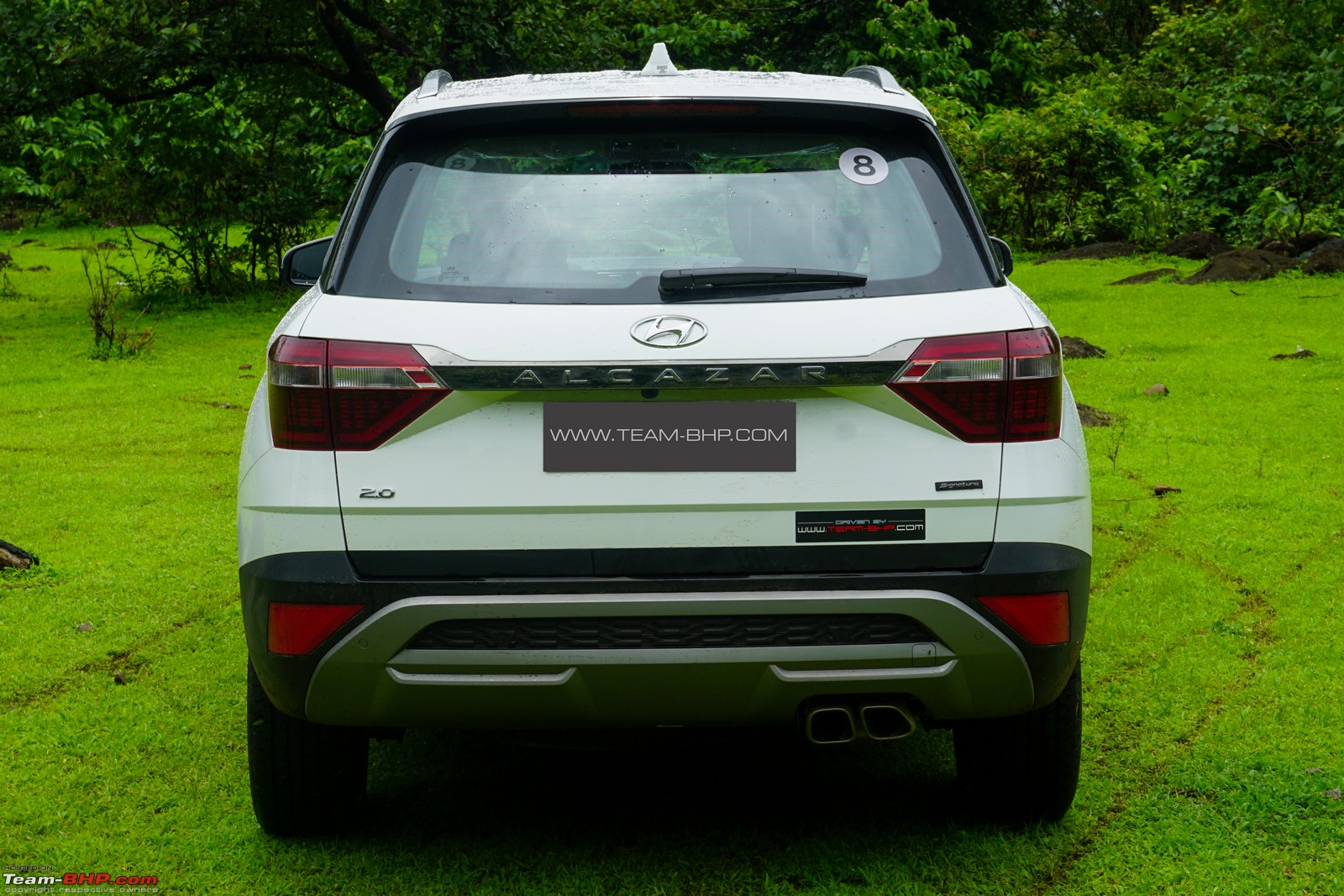
As mentioned earlier, the Alcazar is built on an extended wheelbase platform. At 2,760 mm (150 mm more than the Creta) the Alcazar has the longest wheelbase in its class. And not just the length, the Alcazar rides 10 mm higher than the Creta too with an unladen ground clearance rating of 200 mm:
One of the reasons why most people find the front-end not pleasing is that the design is too busy and over-complicated. Note how the ‘big’ chrome grille is made to look like it splits the ‘big’ headlamp cluster. Even the chrome studs from the grille seem to extend into the headlight. The upper two pods function as the low beam, while the single pod below is used for the high beam: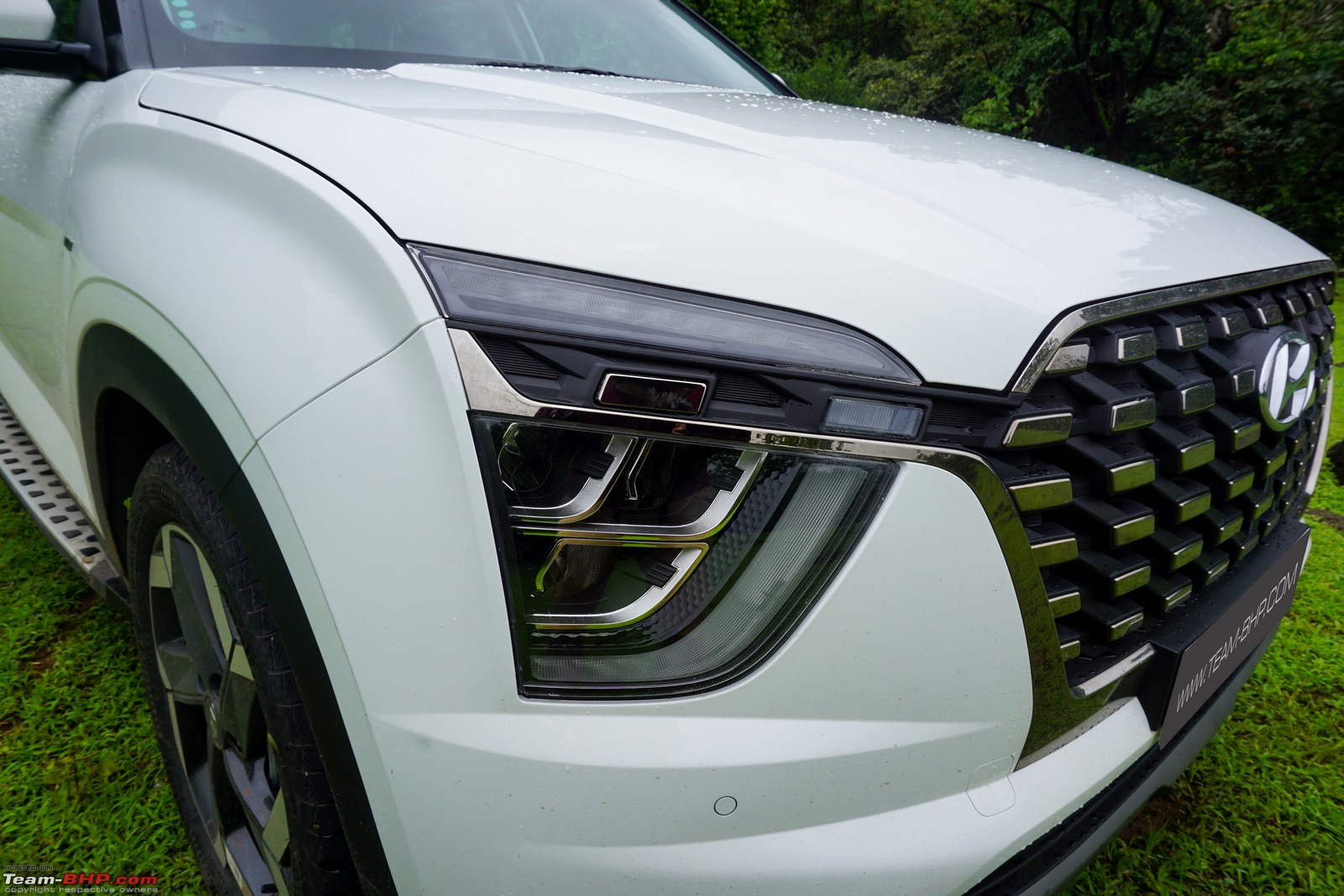
That sure is a lot of chrome! Hyundai calls it ‘Dark Chrome’ but it doesn’t look much different from regular chrome. The tall and wide ‘cascading’ grille gets a thick chrome border and rectangular chrome studs: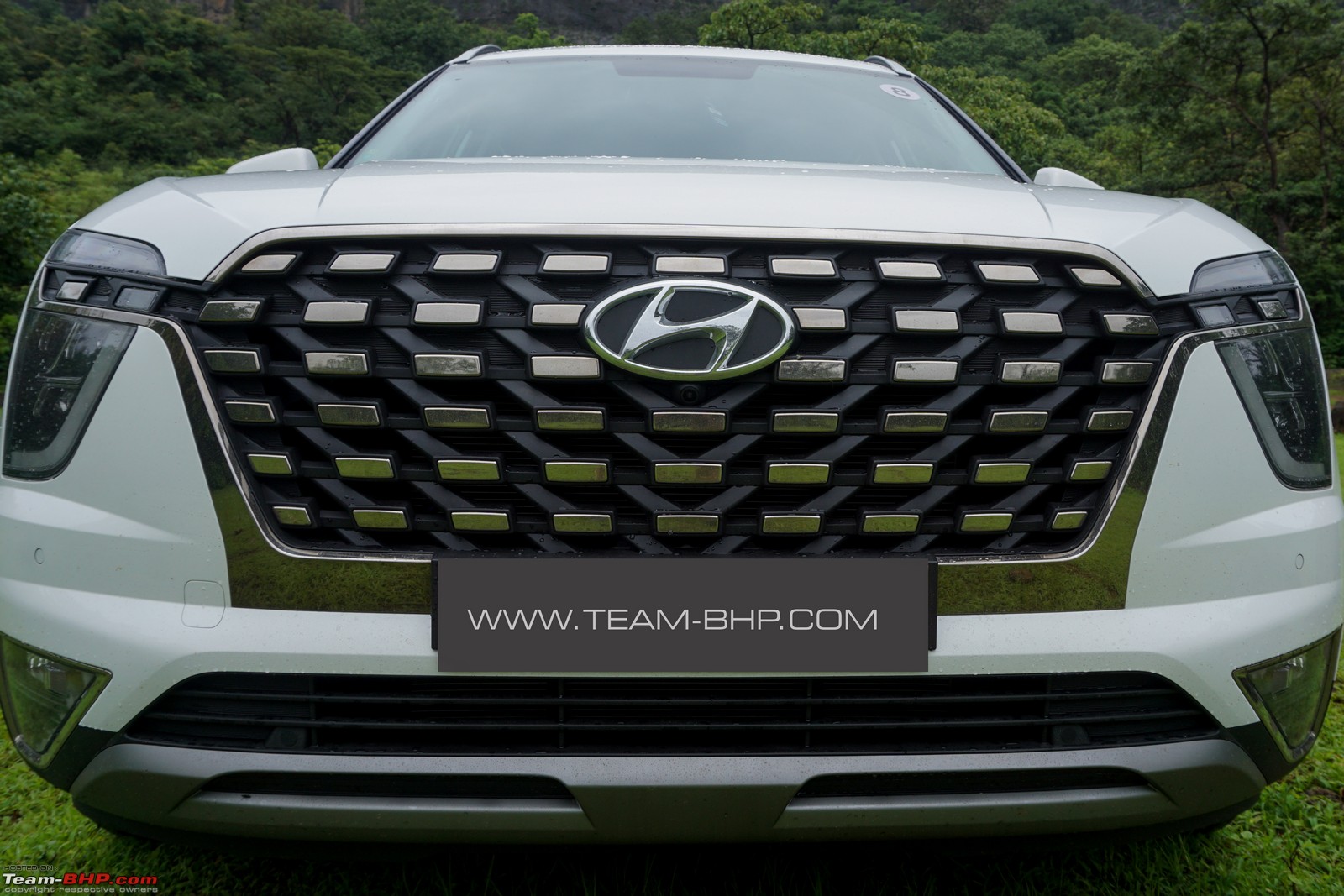
The turn indicators and LED fog lamps are clubbed together in a cluster lower down the bumper. They get a chrome border, but the bigger concern is the positioning of this cluster – it’s too low. The fog lamp aligns with the faux skid plate! 2 out of 3 cars in Mumbai have bumpers that are scratched on corners, and a scratch on this will be an expensive affair: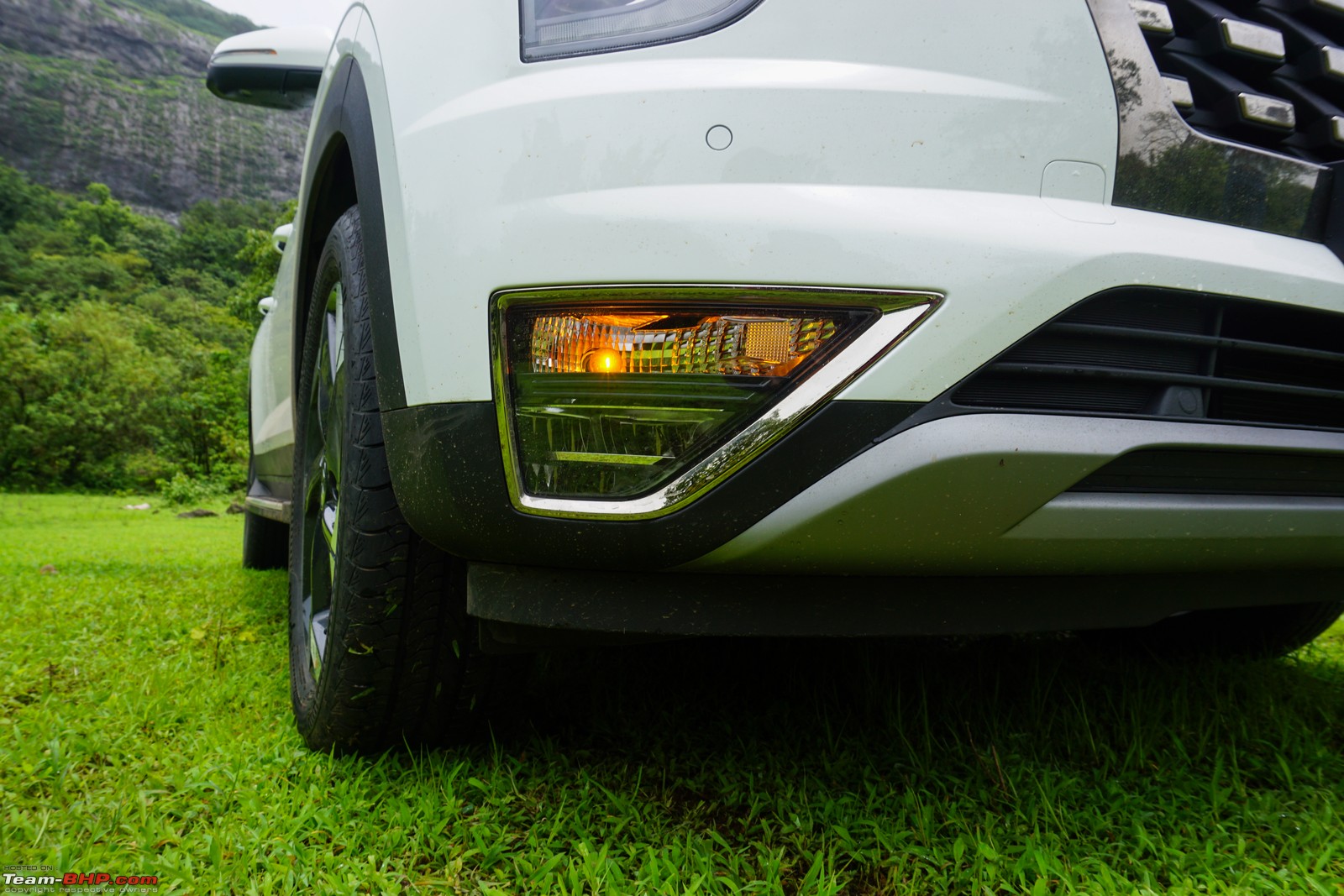
A look at the wide air dam integrated with the faux skid plate. Also, note the wind deflector placed below: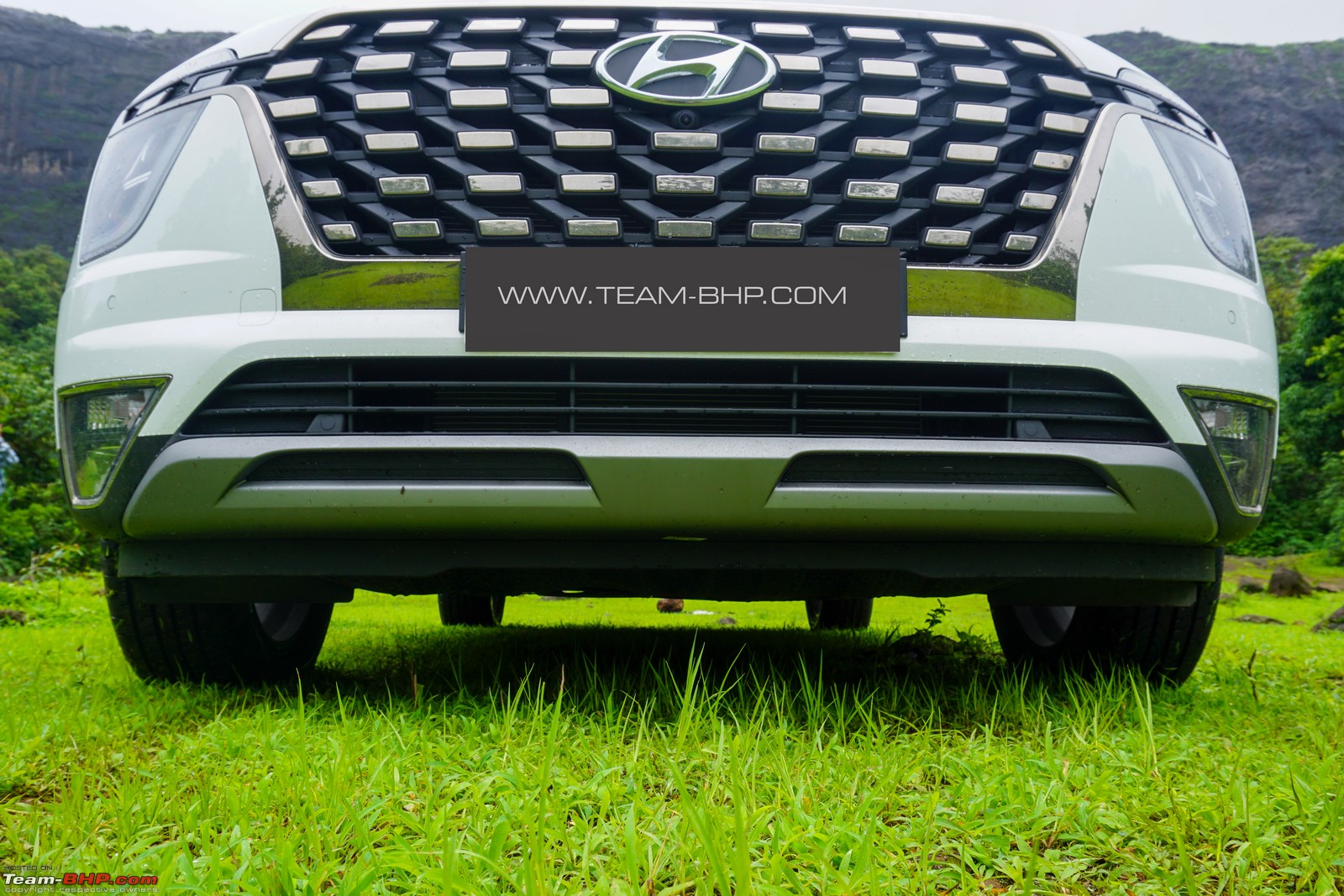
There is a good deal of underbody protection. This is important for India’s unpredictable road conditions: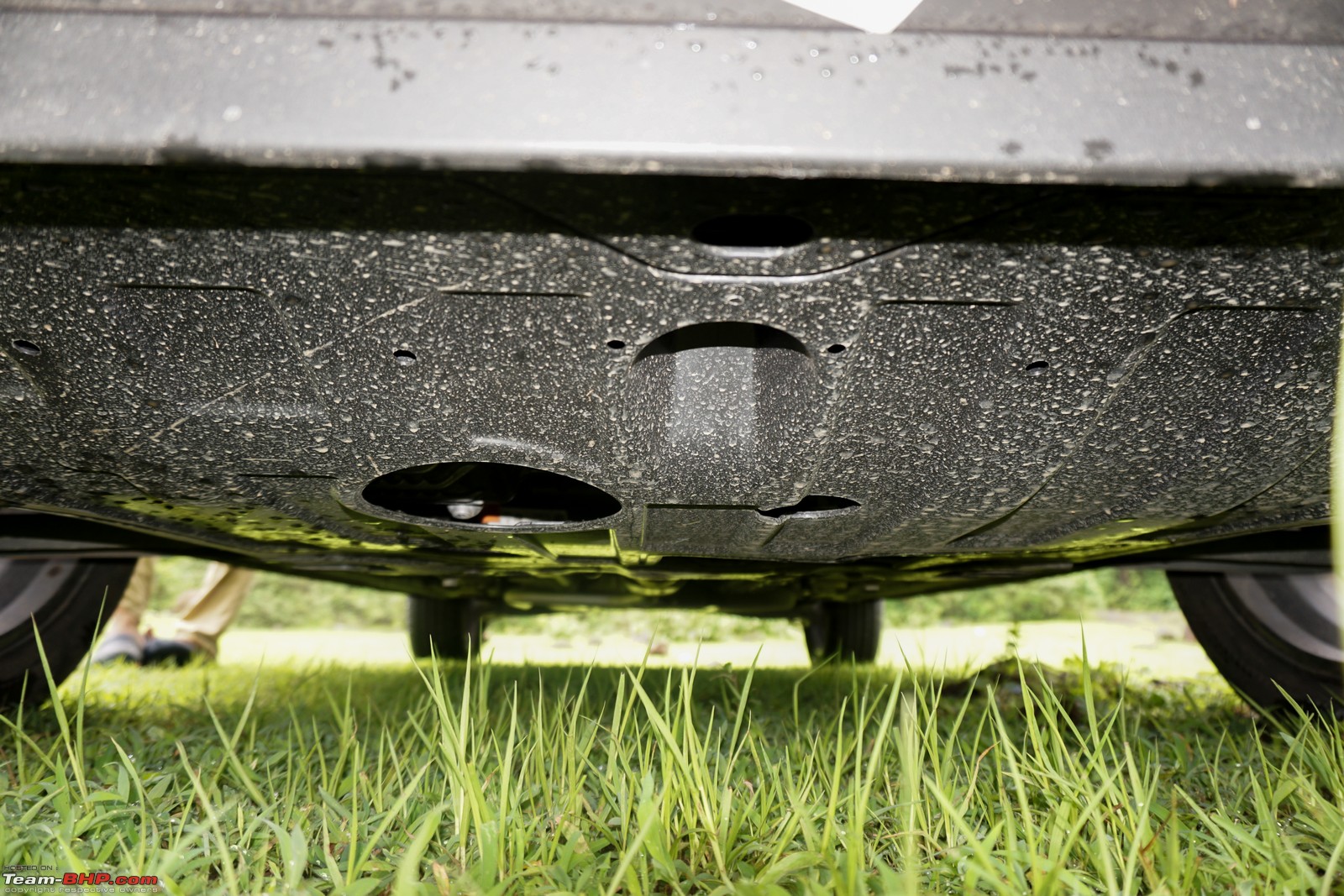
Bonnet features a wide and largely flat central dome, while four prominent creases give it some muscle: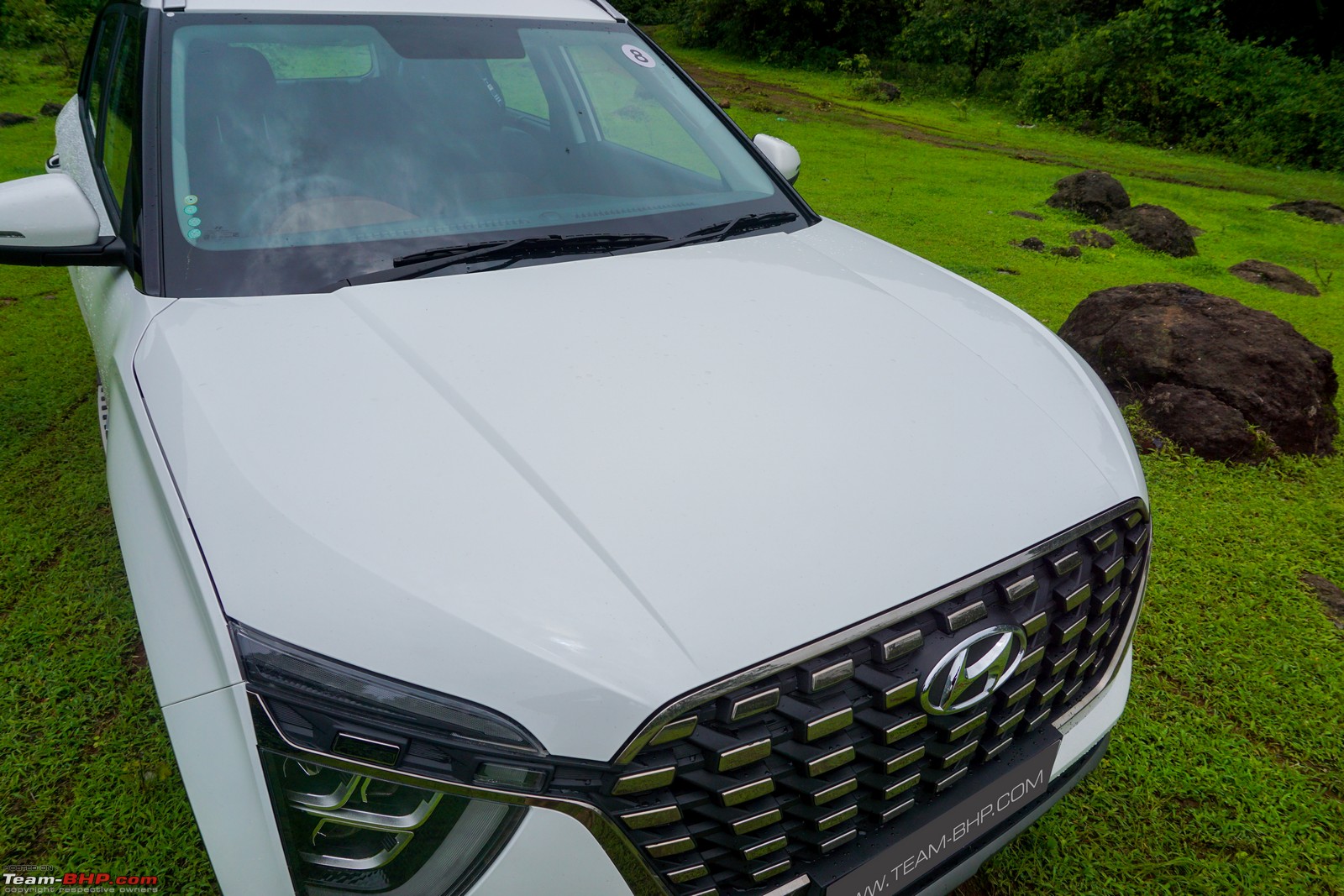
Automatic transmission badge on the fender: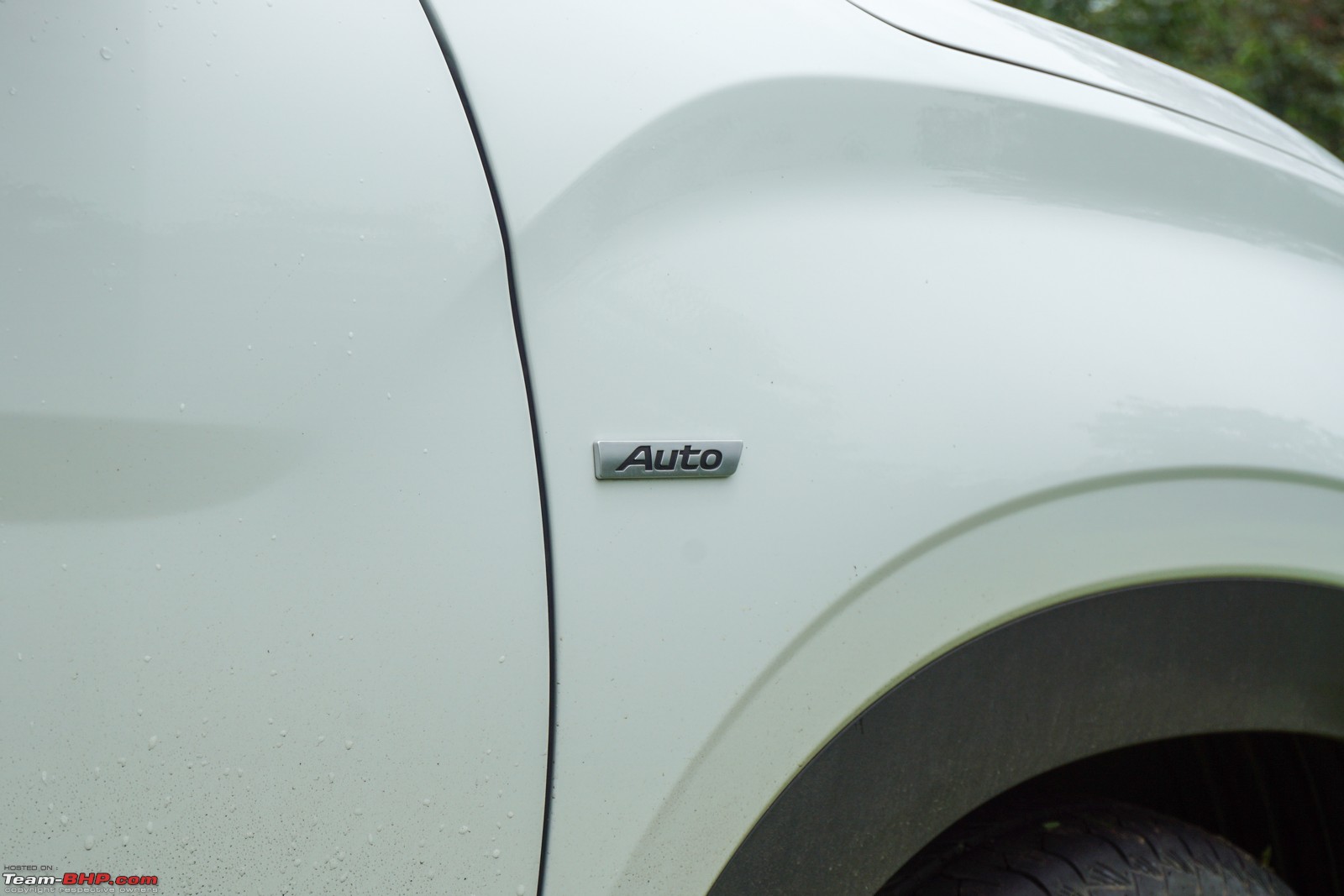
Body-coloured ORVMs are integrated with turn indicators. They are electrically adjustable + foldable, and also have an auto-folding function on lock / unlock: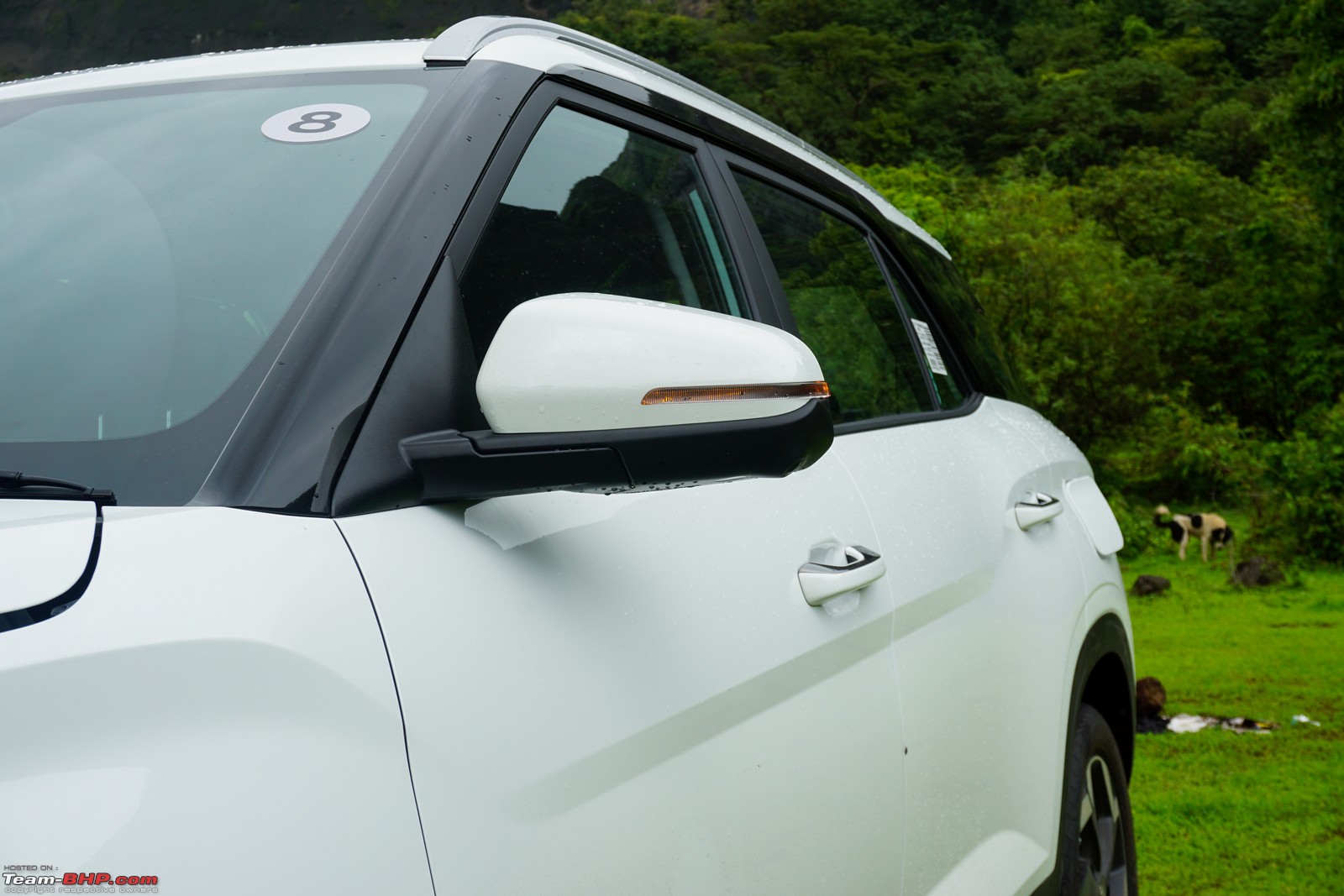
ORVMs house the 360-degree camera and puddle lamps with the Hyundai logo projection (check this image):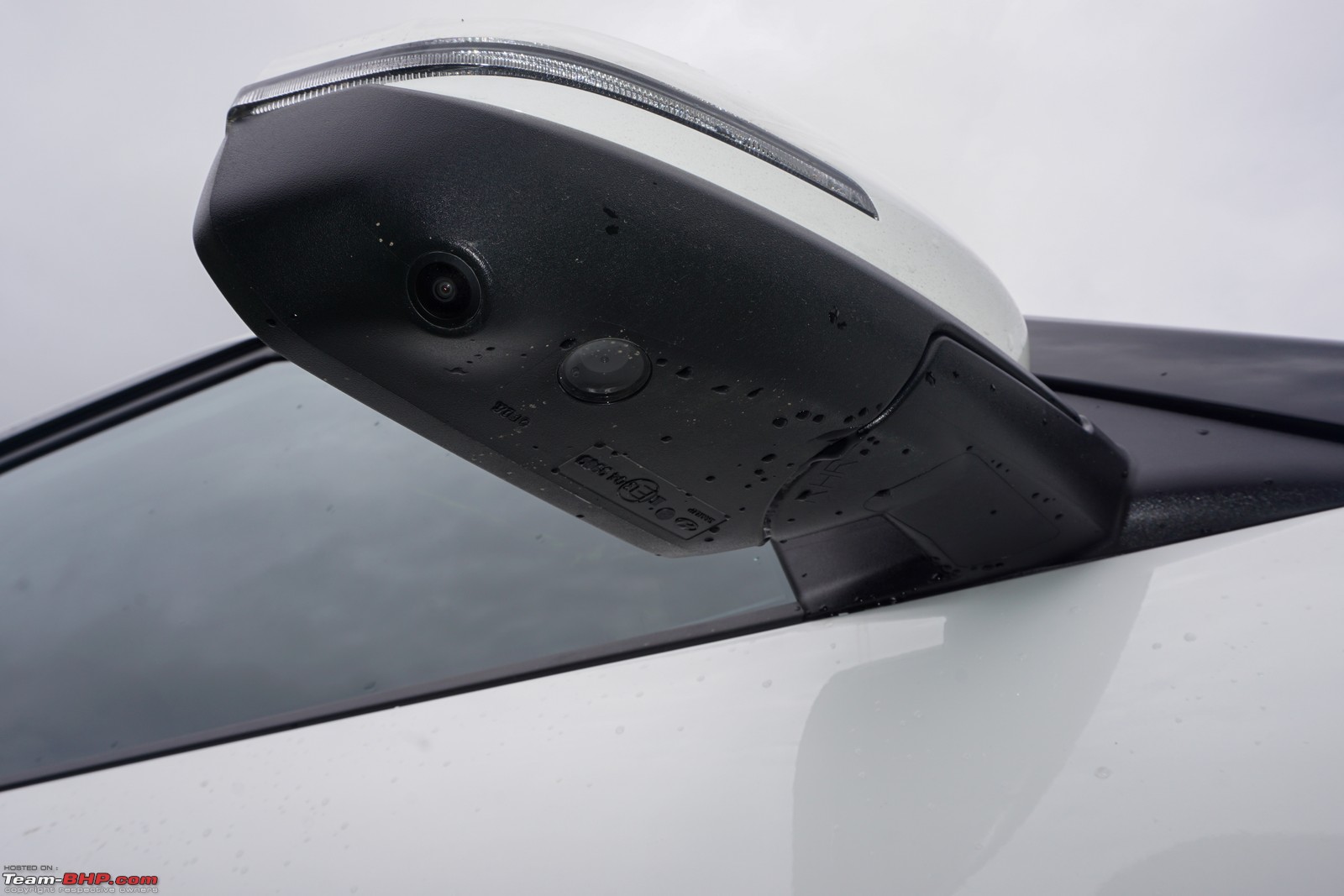
Squared-off wheel wells with flared fender arches and cladding add to the “SUV” look: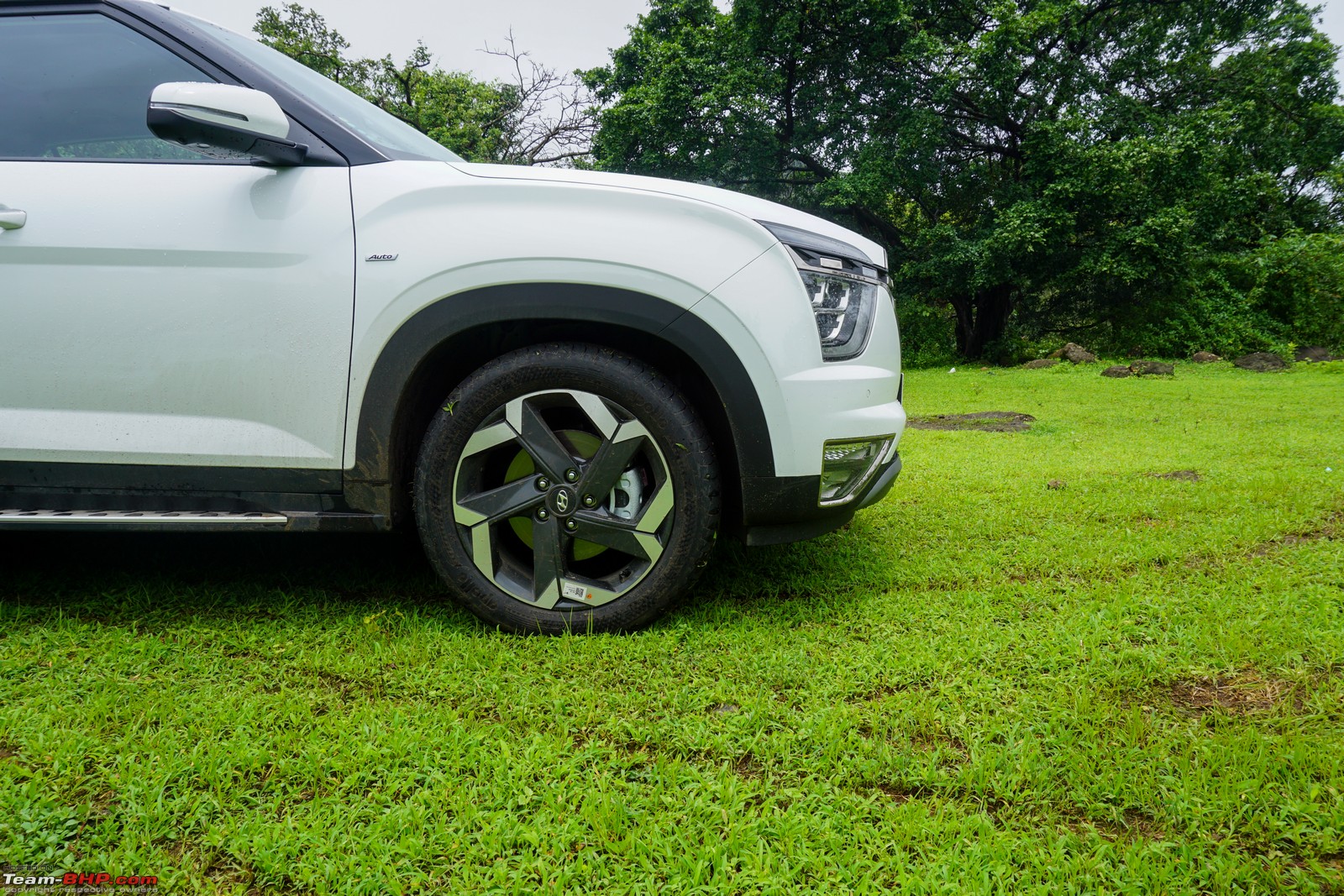
Hyundai has been experimenting with alloy wheel designs, but none have stood out and these 18-inch diamond-cut alloys are no different. They look ‘just okay’ and are shod with 215/55 R18 Apollo Apterra Cross tyres:
One place where the use of chrome is subtle and looks classy are the door handles. Only the driver-side door handle gets the request sensor: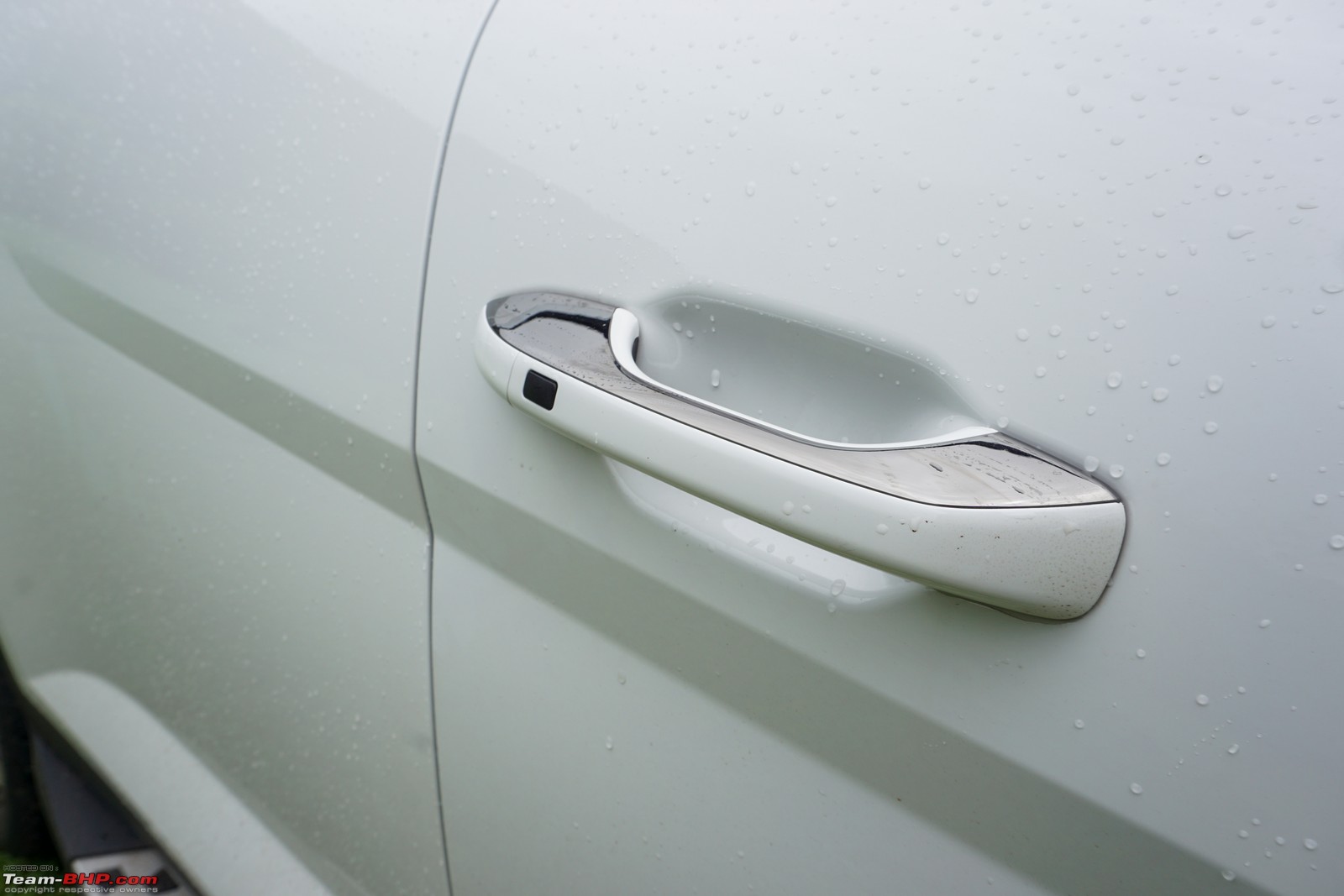
The side foot-step is offered on the mid and top-end variants, but only with the automatic transmission! 
The panoramic sunroof will be a big attraction for Indian families: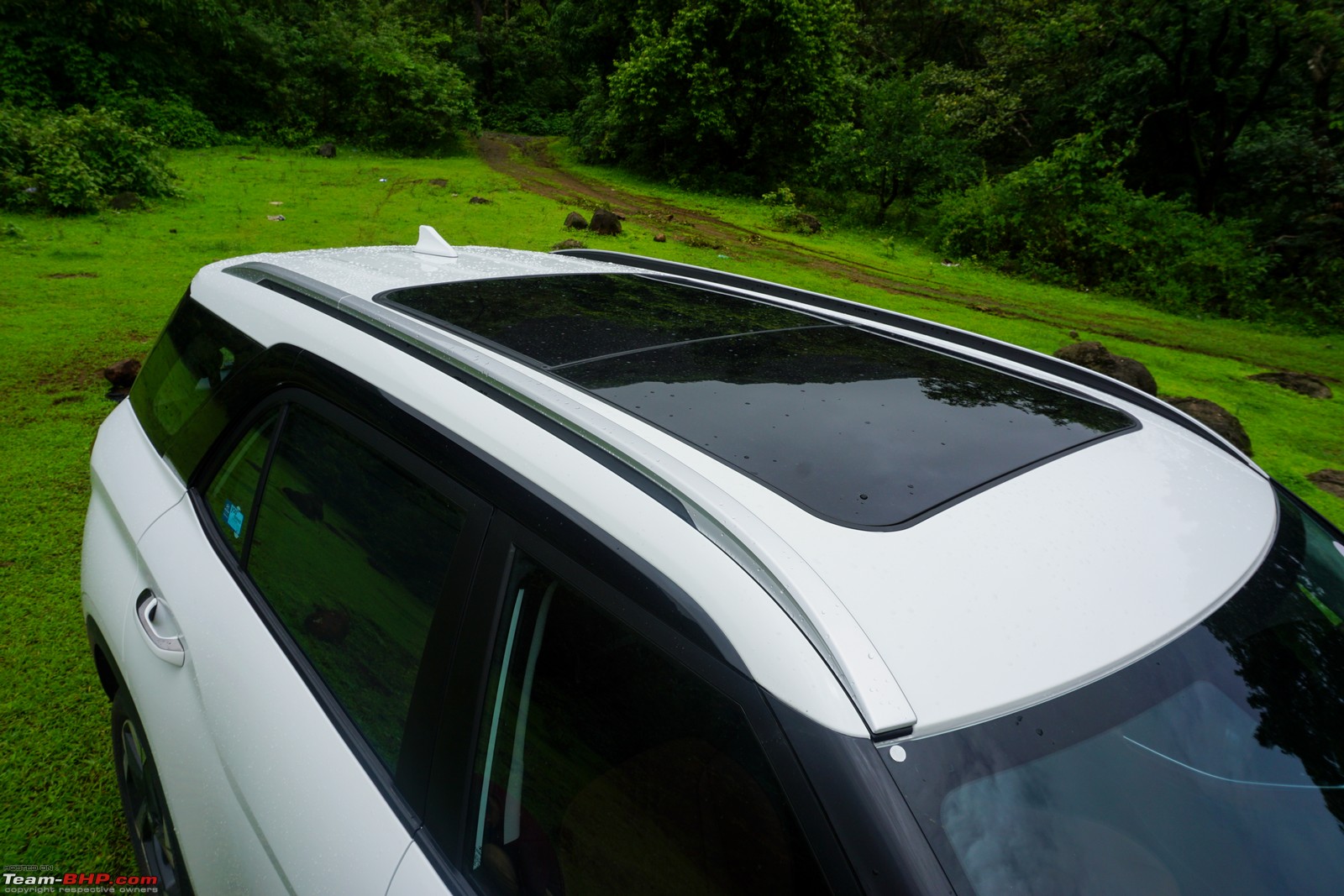
The window line rises as you go from the A to D pillars, yet the glass area is adequate (even for the third row). Glad to see that Hyundai has gone with the conventional boxy SUV design (C-pillar onwards). It adds to the car’s presence and also doesn’t eat into headroom for 2nd and 3rd-row passengers: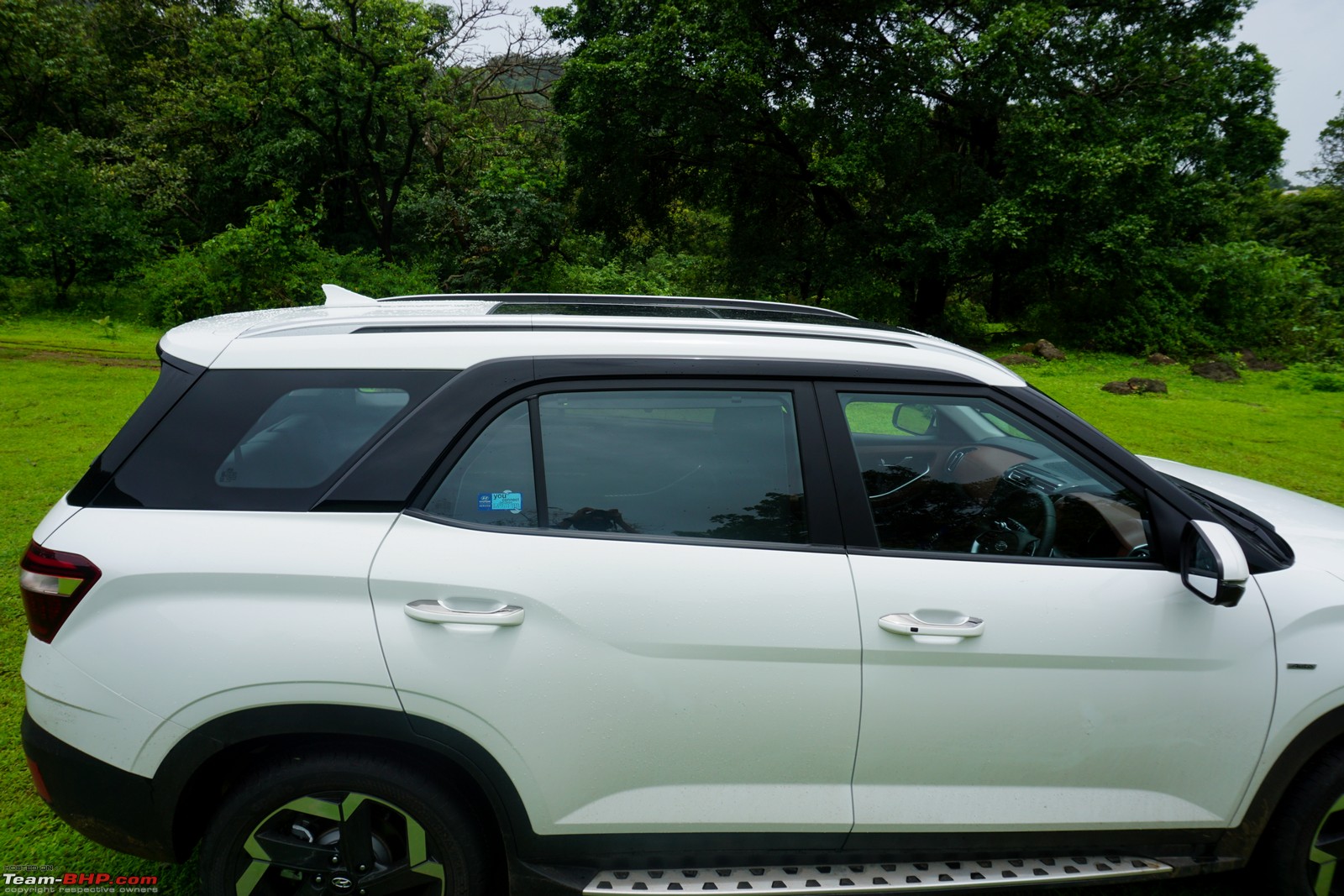
The roof extends into a subtle spoiler. It houses the HMSL as well as the rear washer: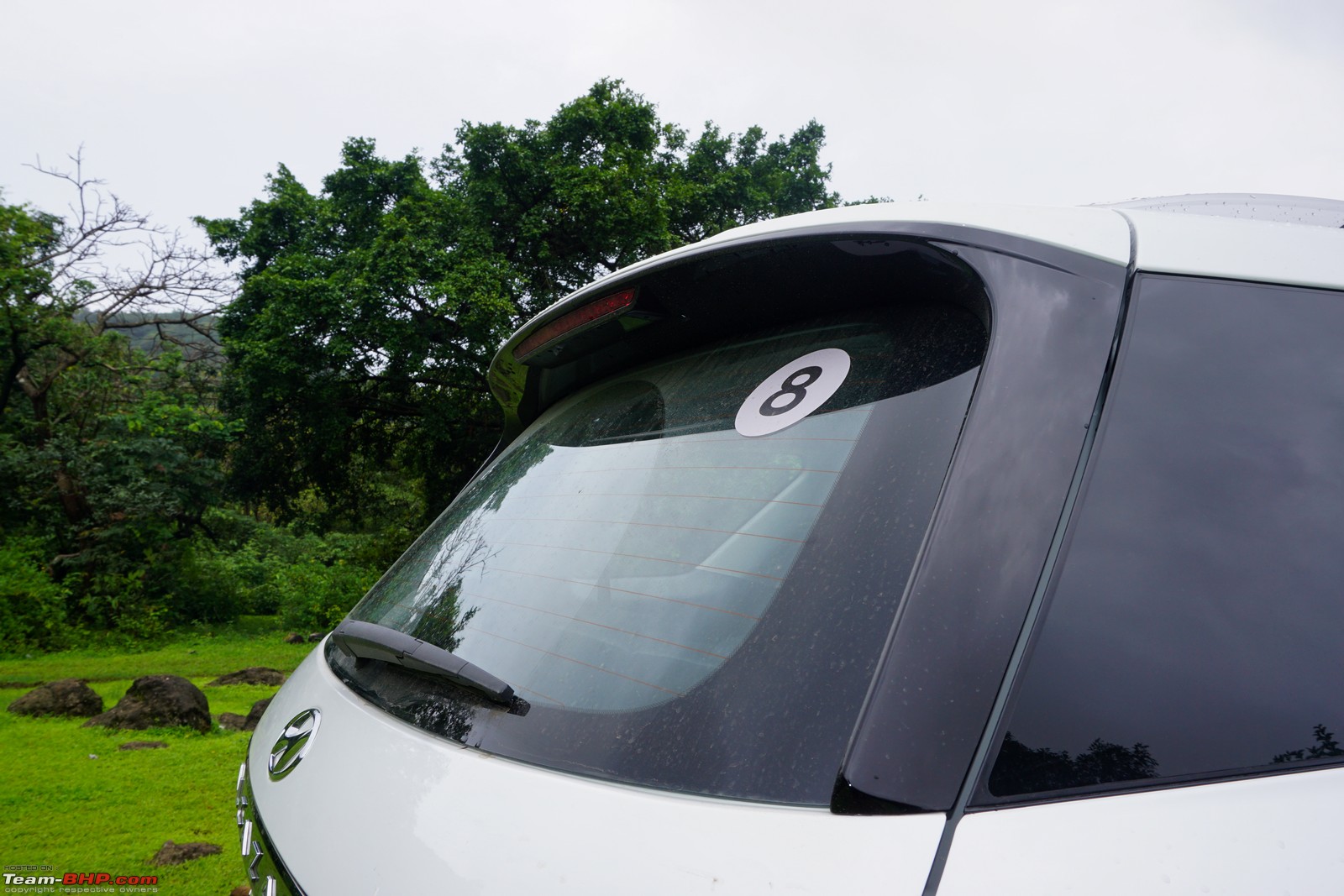
Endeavour-esque rear for sure! Tail lamps are connected via a thick chrome strip and carry the ‘ALCAZAR’ branding (means a Spanish palace or fortress). The 2.0-litre petrol test car that you see here gets a nice ‘2.0’ badge on the bottom left: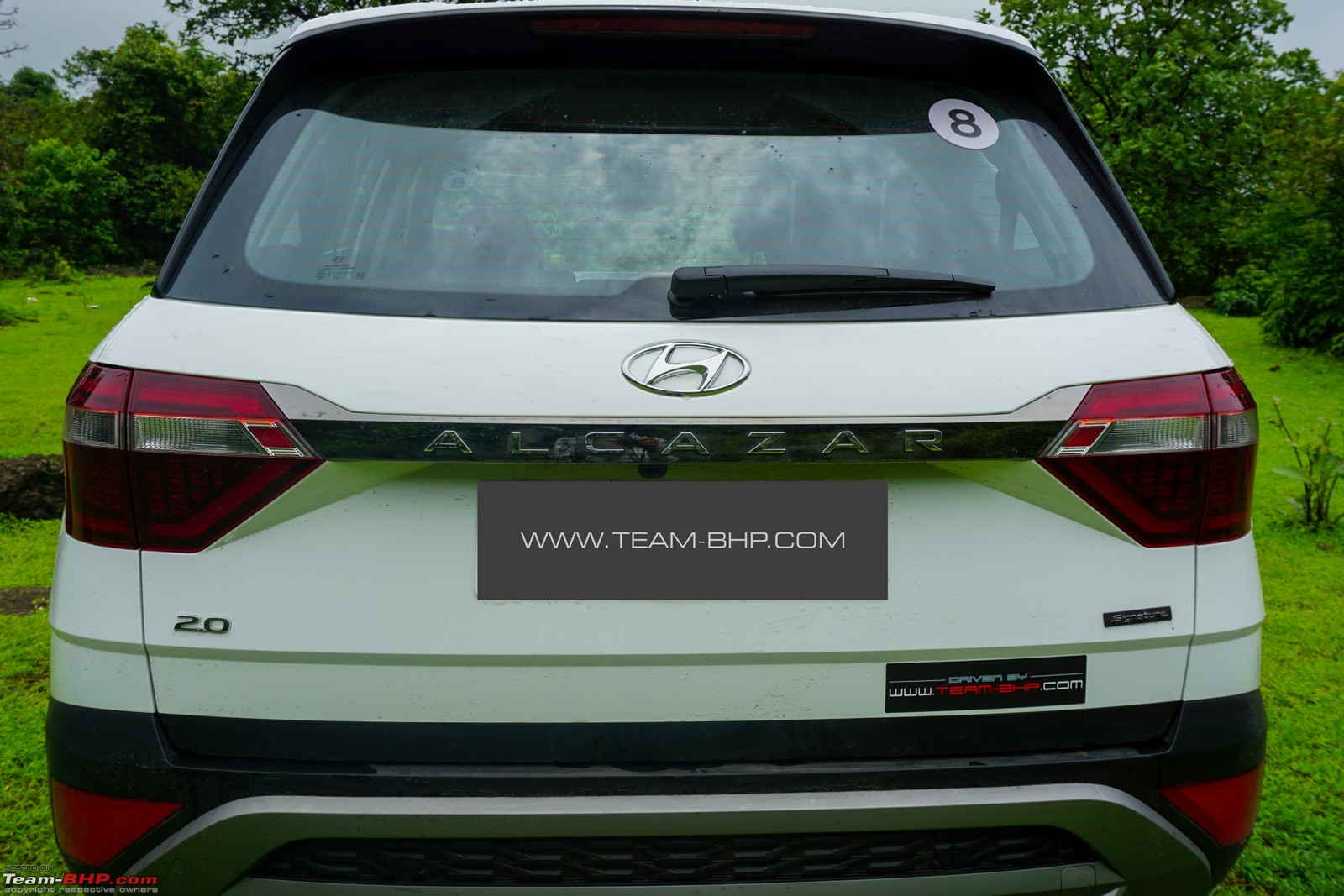
LED tail lamps have a honeycomb-inspired design. They get an LED element as a border and reversing light, along with turn indicators in the middle:
Lower bumper houses reflectors on either side and a faux skid plate. The twin-tip exhaust looks sporty and unlike the Creta, it’s standard across all variants. That being said, they look misaligned which isn’t something we usually see on Hyundais: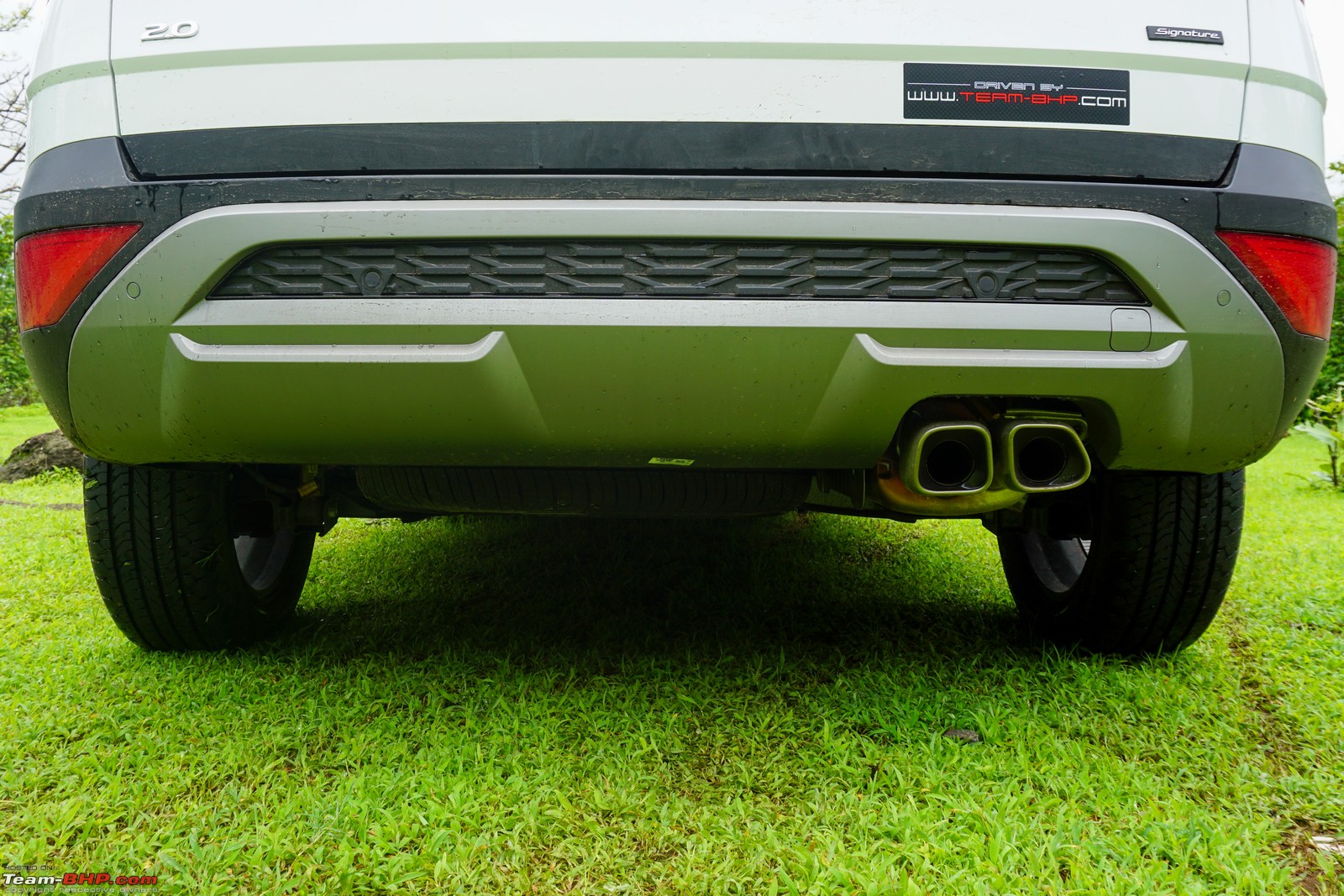
The spare wheel is tucked under the car. It’s a 17-inch steel wheel shod with a 215/60 R17 section tyre: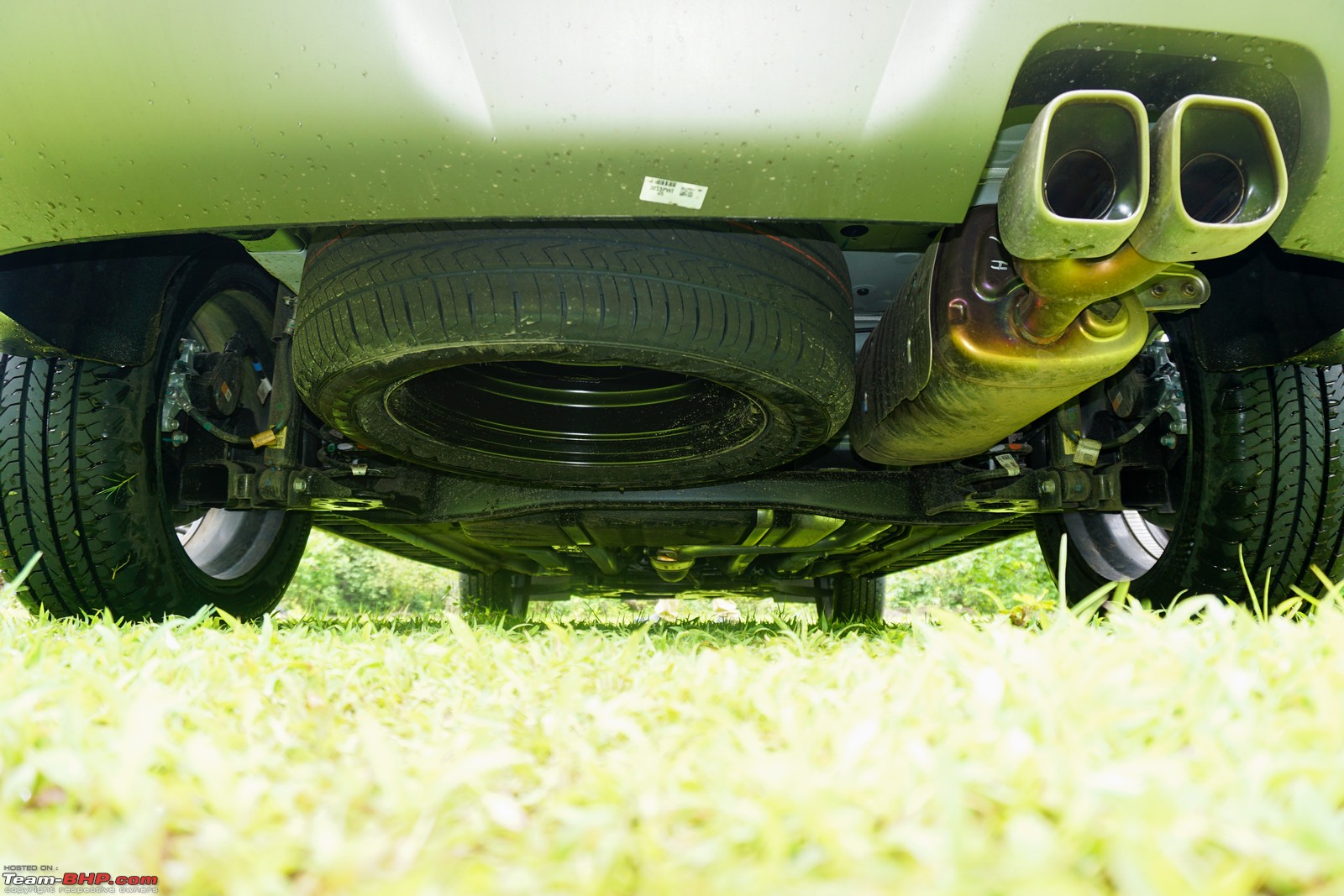
The fuel tank has a capacity of 50-litres: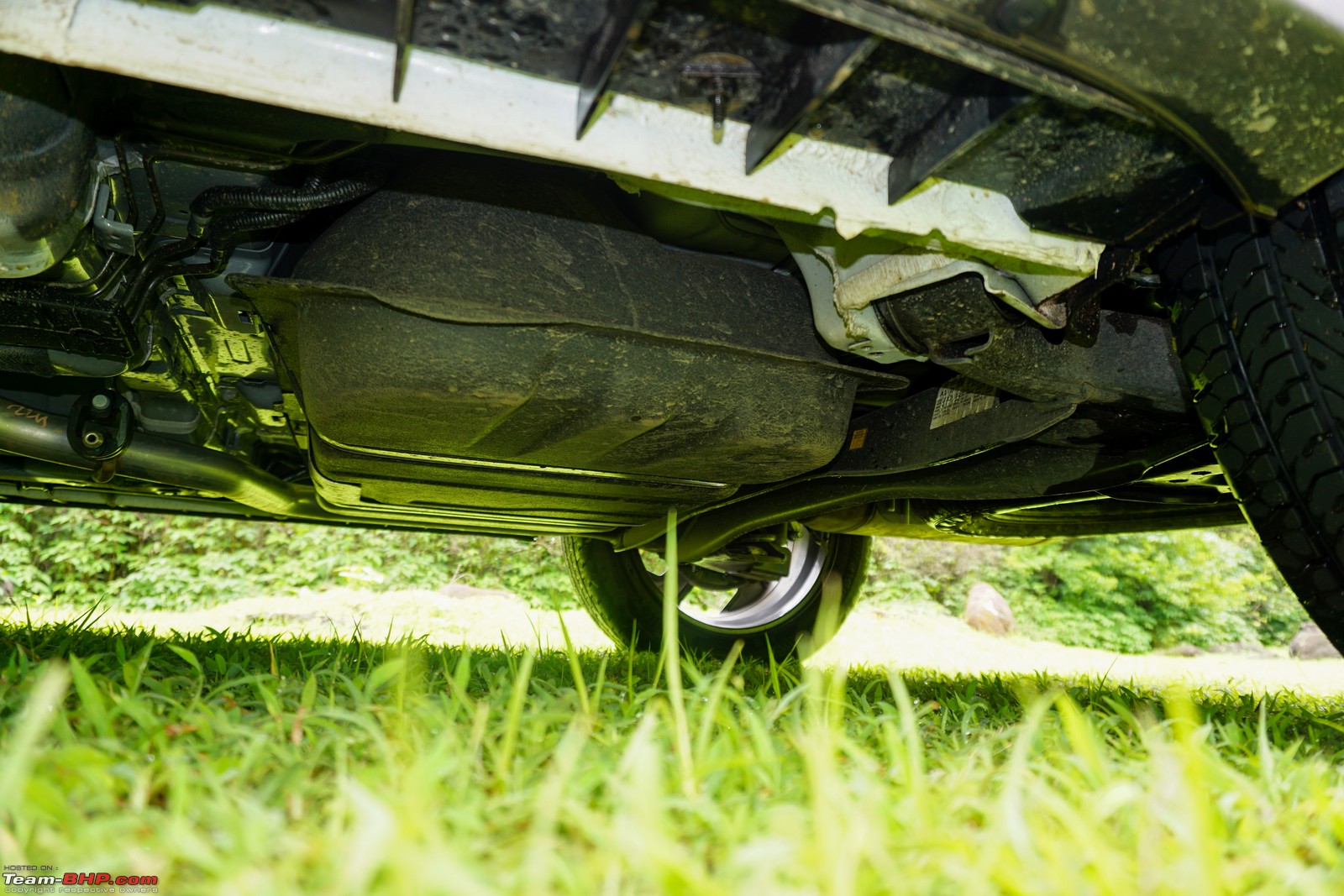
Paint options include Polar White (our test car), Phantom Black, Starry Night, Typhoon Silver, Titan Grey & Taiga Brown. Dual-tone paint schemes are offered only on the top-end Signature trim in Polar White with a phantom black roof and Titan Grey with a phantom black roof. Here’s the car in Taiga Brown…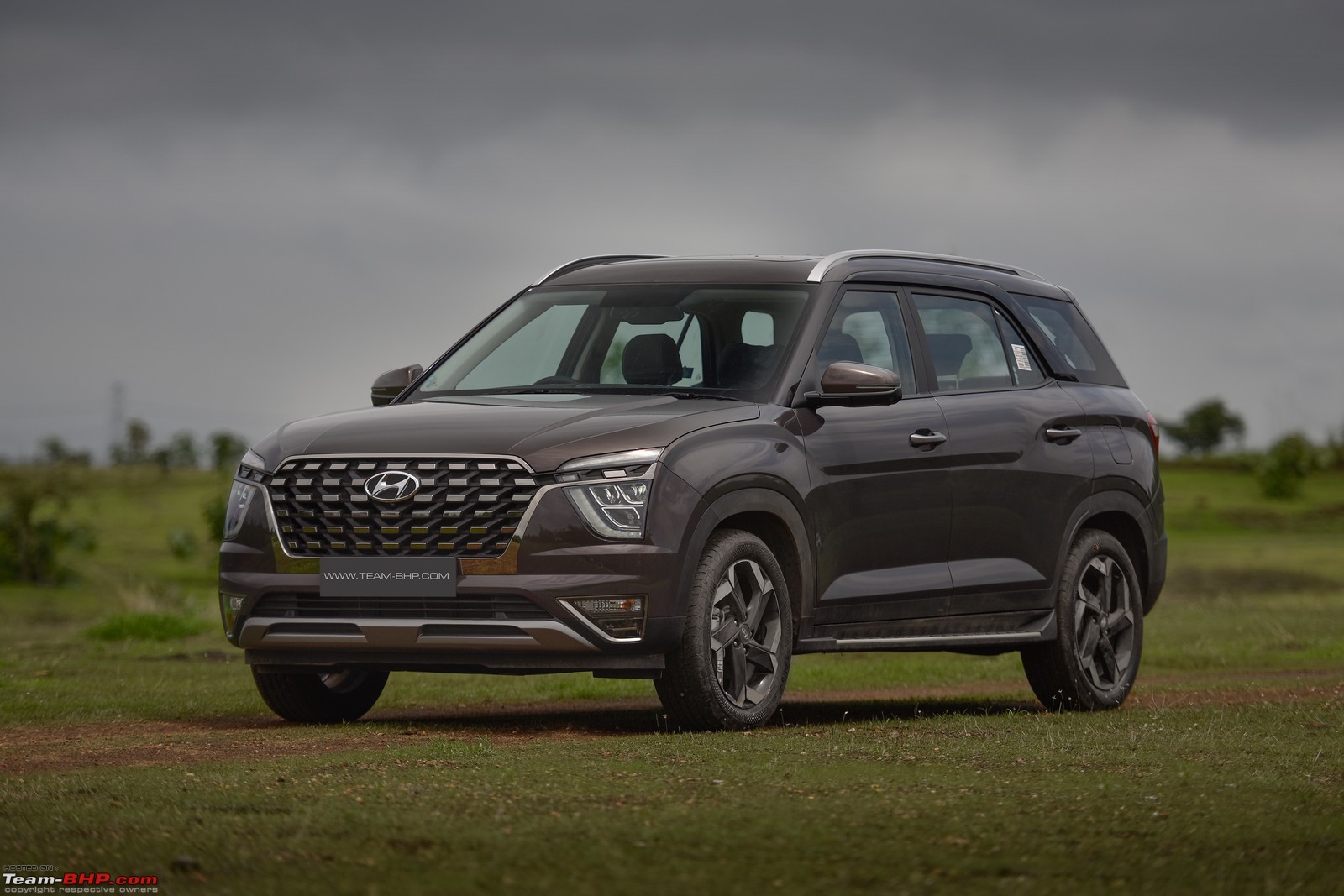
…and Typhoon Silver: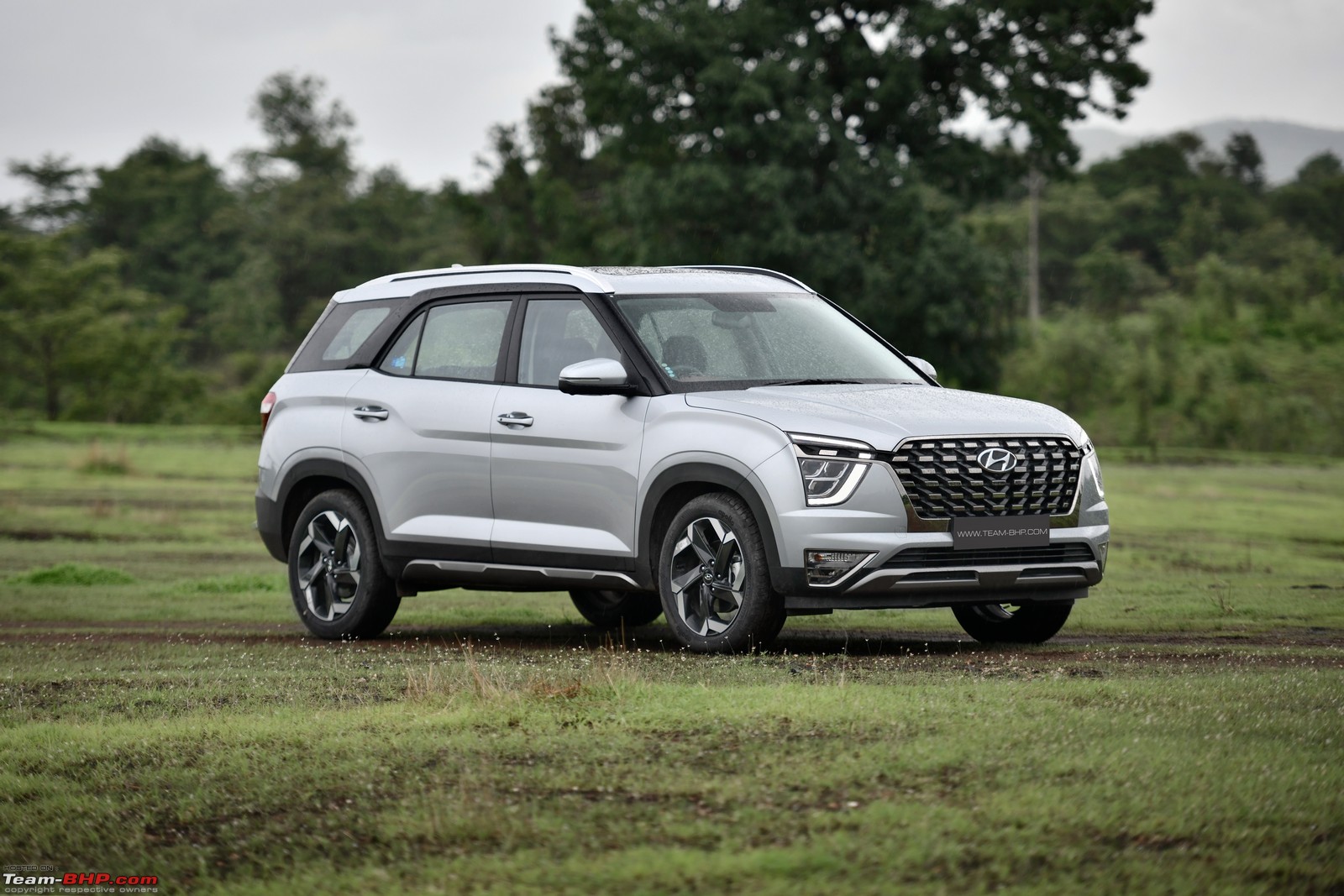
Last edited by GTO : 25th June 2021 at 12:05.